

“The market for saddle stitched products has become increasingly demanding”
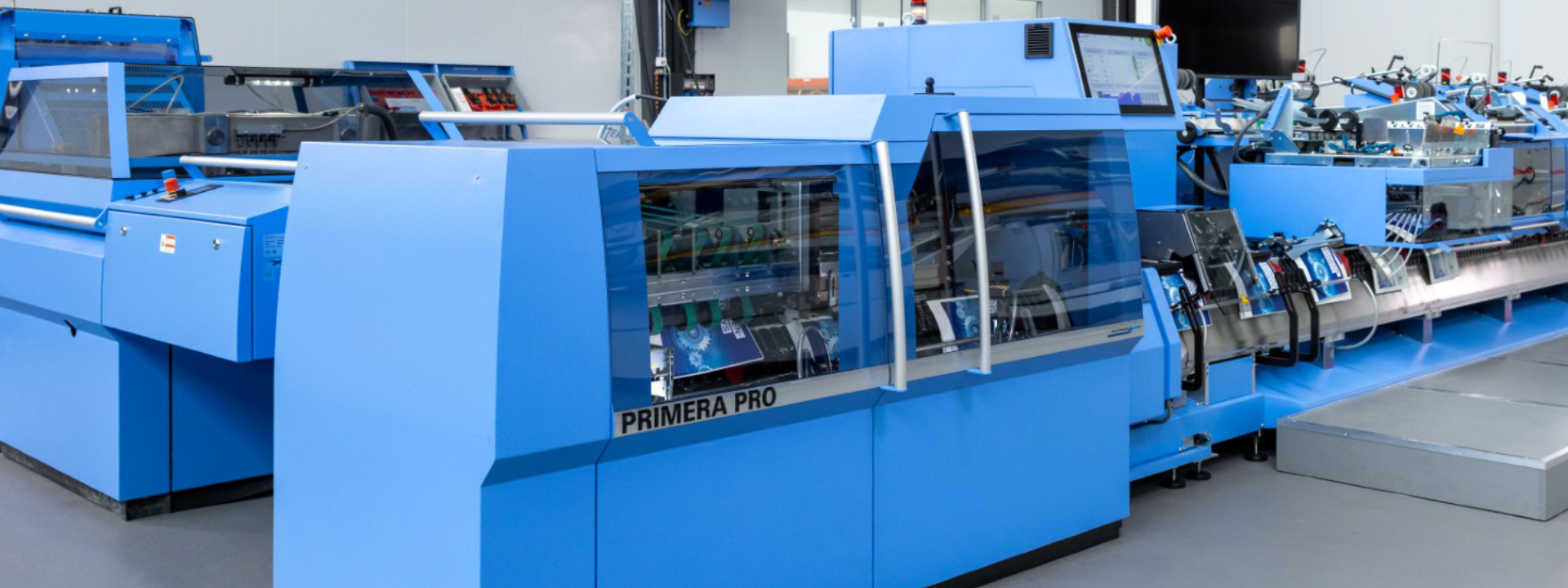
To replace a Primera MC and an ST 450, Kern GmbH in Bexbach, near the German city of Saarbrücken, will begin operating two new Primera PRO saddle stitchers from Muller Martini this late summer. In doing so, the family-owned company is improving its market prospects in several ways.
Although Kern GmbH, which employs about 150 people, also produces approximately 4 million softcover products annually on a KM 610A perfect binder, saddle-stitching is by far the larger segment in terms of volume, with about 40 million copies – primarily offset-printed – per year. According to the two company owners and managing directors, André and Holger Kern, this is because “a great many of our customers use saddle-stitched binding for traditional brochures, magazines, inserts, training materials, industrial documents, and pharmaceutical and informational printed materials. These products are often slim, have tight deadlines, and must be produced extremely efficiently.”
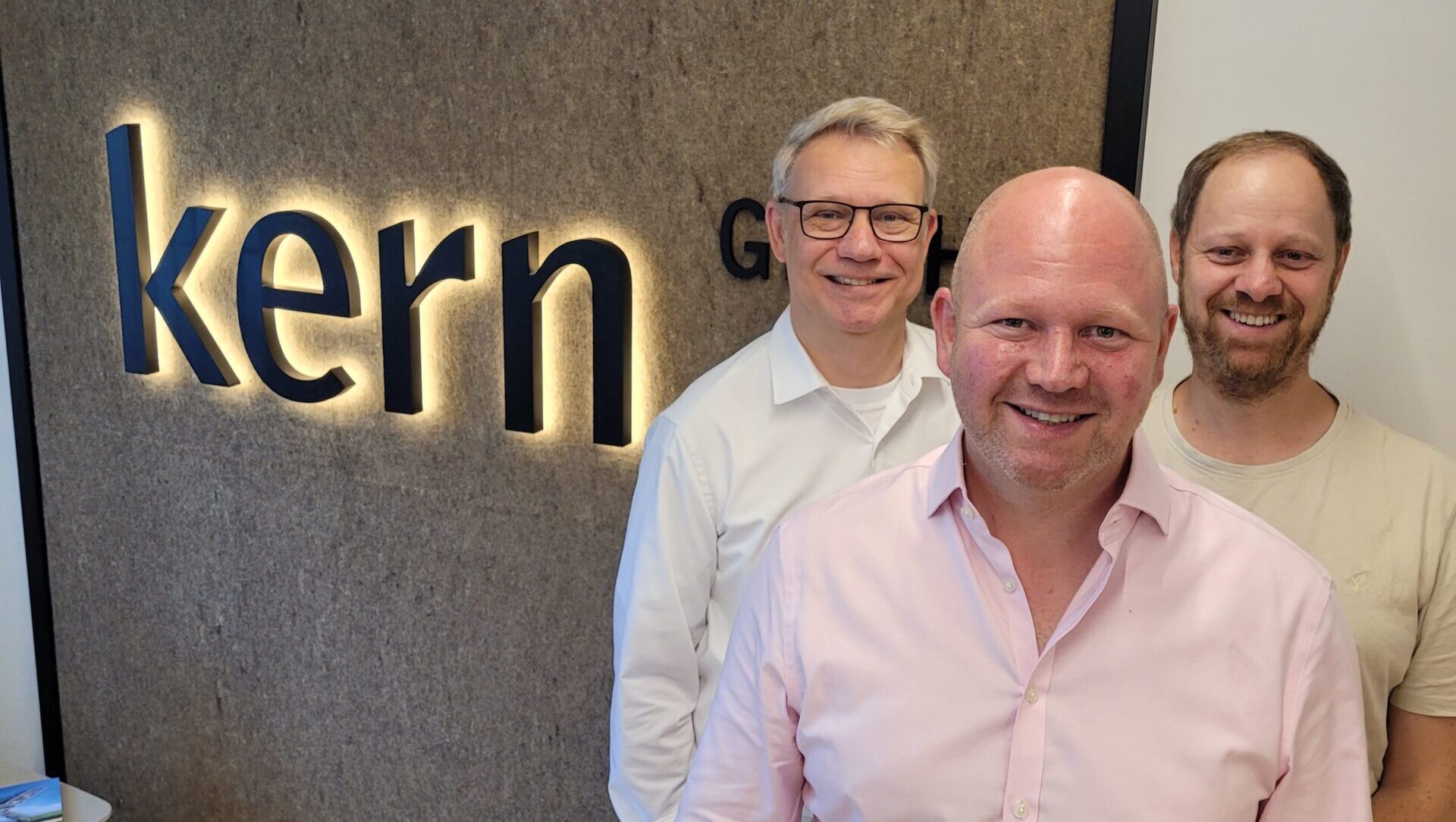
Brothers André (center) and Holger Kern (right) run the family-owned company Kern GmbH. On the left is Volker Keppler (Regional Sales Manager, Muller Martini Germany).
In recent years, saddle stitching has actually gained in importance at Kern. According to André Kern, “this is less because softcover products have become unimportant, but more because the market for saddle stitched products has become increasingly demanding. Customers today expect very high quality, very short lead times, and competitive prices at the same time.”
A product range characterized by great diversity
At the same time, product diversity has also increased significantly: different formats, varying paper qualities, small and large print runs, special requirements, dual-purpose applications, ring-eyelet binding, camera inspections, and highly precise finishing (large volumes with good trim quality and exact dimensional accuracy).
The product range is very broad, extending from small jobs to print runs in the millions. The products vary greatly in format – from classic brochures to training and informational materials, all the way to industrial and pharmaceutical products. According to Holger Kern, pharmaceutical and industrial customers in particular place high demands on process reliability, repeatability, and quality. “With such products, feeders, sheet sequence, completeness, and finishing must be monitored very reliably.”
A hallmark of Kern is that its saddle stitching operations produce more than just simple standard brochures. The highly diverse product range encompasses a wide variety of formats and page counts, double-use productions, inserts, sticker/cardboard sheets, truncated product sections, ring-eyelet bindings, and products with special requirements for folding, trimming, camera inspection, and packaging. “By investing in two new Primeras PRO, we are laying the foundation to keep this division at the cutting edge of technology in the long term and to further expand our capacity in industrial three-shift operation,” the brothers emphasize.
Five reasons for choosing the Primeras PRO
Kern chose the two Muller Martini models for five reasons
- First, the saddle stitching sector requires very high industrial performance. This is because the systems are used in continuous three-shift operation. This means that machine availability, stability, and net output are crucial.
- Second, due to the extremely high product variety, saddle stitchers are needed that can be quickly retooled.
- Third, ease of use plays a major role. Kern will train a dozen machine operators on the new systems right away. This is because, for cost-effective three-shift operation, it is important that not only individual specialists master the machines, but that a broad team can work with them reliably, consistently, and efficiently. Modern user interfaces, clear setup processes, and good job repeatability are therefore particularly important.
- Fourth, Kern aims to ensure the long-term technological sustainability of its finishing operations. “The market demands high quality, very short lead times, and competitive prices. This can only be achieved with modern technology, stable processes, and high availability,” emphasizes Holger Kern.
- And fifth, not least, the positive experience with the Primera MC – which, like the ST 450, is being retired – played a role. “We’re familiar with Muller Martini technology from our daily industrial production and have had good experiences with it – especially in terms of performance, process reliability, and suitability for demanding products. At the same time, we were aware that we needed to take the next technological step,” the Kern brothers emphasize.
Improved market opportunities in several respects
The two Primeras PRO are configured almost identically. The only difference: one is equipped with four flat-stack feeders in addition to the cover feeder, while the other has eight. The smaller machine still features six chain-driven bases, allowing the feeders to be swapped between the two saddle stitchers. Special accessories such as double-sheet feeders and ring-eyelet stitching heads are also compatible. This means Kern can, in principle, produce all products on both machines.
“We decide which configuration makes the most economic sense depending on the job,” says André Kern. “Smaller or simpler products can run on the more compact system, while more complex products can run on the larger one. If necessary, however, we can also swap out components and thus respond very flexibly to the current order situation.”
Production on the two new Primeras PRO is scheduled to begin this coming August and September. The two company owners are confident that this will improve their market prospects in several ways: in terms of higher productivity in a market where short lead times, on-time delivery, and competitive prices are crucial, as well as in terms of handling more sophisticated products and achieving greater flexibility.
