“The multi job function is impressive”
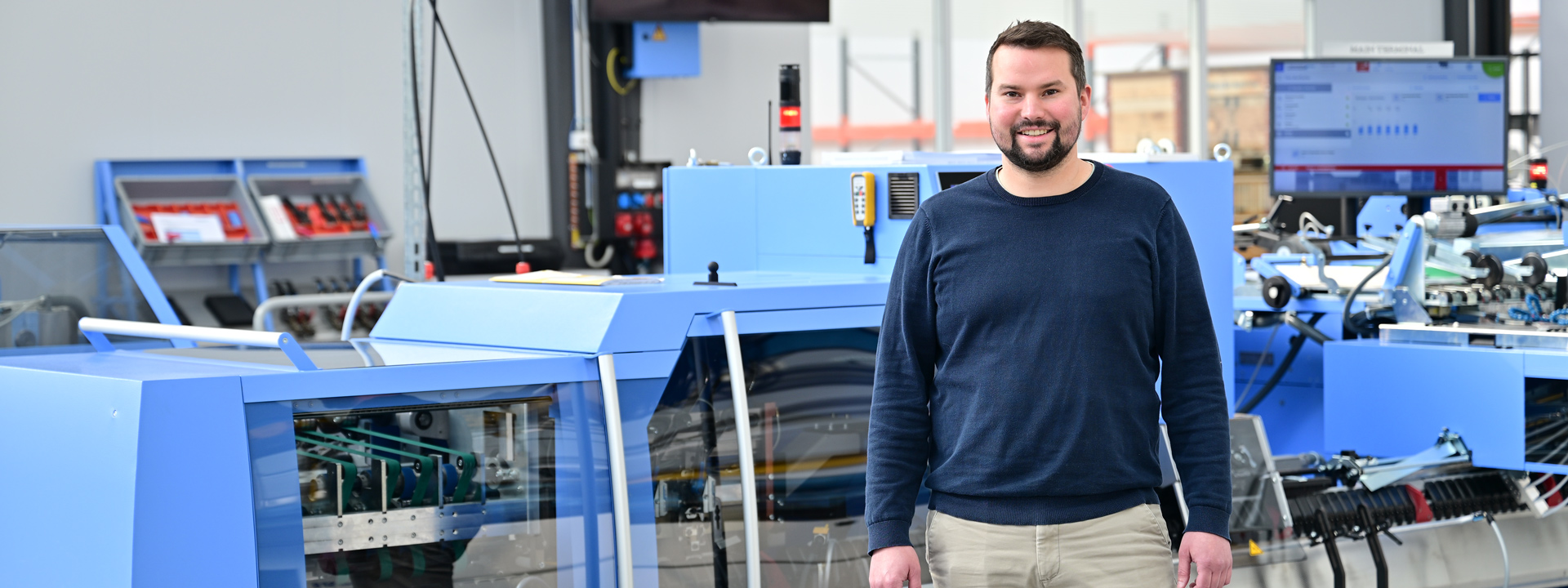
My name is Simon Kunz, and I recently joined Müller Martini as a product manager for saddle stitchers. Over the first few months, I got to know a wide range of technologies in detail. There was one feature that immediately impressed me, because it truly makes a huge difference in day-to-day operations: the multi‑job function of our saddle stitchers, above all in the Primera PRO.
It’s unbelievable just how much potential this function has to offer. The machine understands what it has to do next and keeps production up and running continuously, even with lots of small jobs. That’s where the Primera PRO, which produces at up to 14,000 cycles per hour, shines. Thanks to the multi-job function, it processes jobs sequentially without an operator having to intervene. This is especially valuable for print shops frequently processing small runs or varying covers with identical content.
Save time and money
What really impresses me is that signature sheets for multiple jobs can be in the same feeder hopper, while the machine automatically ejects any signature sheets that are no longer required. Previously, excess products had to be removed manually, which was a lot of work. Today, with the multi-job function, this process is completely automatic, running without interruptions. All this saves time, reduces staffing requirements, and minimizes sources of error.
Process automation
Another convincing aspect is the additional combination with streamfeeder loading. This improves ergonomics for the operator, further reduces staffing requirements, while also boosting net output. The machine runs more reliably, uptime and downtime are optimized, and standstills are reduced significantly.
At the end of the process chain is the fully automatic, thickness-variable three-knife trimmer, which performs all format and thickness settings automatically thanks to state-of-the-art Motion Control Technology. Again, manual interventions are a thing of the past.
The benefits of multi‑job production can be clearly summarized:
- automatic job change,
- higher net output, and
- maximum flexibility for digital and conventional production.
Digital or conventional
Hybrid productions also benefit enormously, as the multi‑job function brings advantages in both digital and conventional environments. In digital production, the “little brother” Prinova Digital is mainly used, also delivering an impressive performance at 9,000 cycles per hour. Efficient production benefits particularly from an automated, end-to-end workflow like the one our workflow system Connex enables. It covers all process steps, from imposition to the finished, saddle-stitched product.
Quick and easy setup
What also fascinates me is the intuitive operation, which I experienced myself as a “saddle stitcher newbie.” The operating concept with context-dependent displays makes control extremely user-friendly and speeds up production processes considerably. The Primera PRO is not only a state-of-the-art machine, but also provides for easy handling and high productivity.
For me, the multi‑job function is one of the features you have to see for yourself to understand the level of efficiency, freedom, and automation it has to offer. It makes production faster, more flexible, and more cost-effective – and shows what modern saddle stitching has to look like today. As a product manager, this never stops amazing me.
Would you like to get to know our multi-job function? You can experience it live at our Print Finishing Center in Zofingen, Switzerland. I would love to show you in person how you easily you can optimize your production with it.
Best,
Simon Kunz
Product Manager Saddle Stitching